The Government has published its “Accelerating Infrastructure Report and Action Plan” (the Report), proposing a series of actions that aim to accelerate the delivery of critical infrastructure. The Report:

  • highlights water, electricity and transport as critical infrastructure;
  • restates the 12 barriers to infrastructure in Ireland, which were identified by the Accelerating Infrastructure Taskforce (Taskforce) in its July 2025 report on Stakeholder Consultation and Engagement on Infrastructure; and
  • sets out a timeline of thirty actions under four key pillars to assist acceleration of infrastructure delivery.

The proposed actions to accelerate infrastructure include legislative reform, simplifying regulatory processes and increasing public acceptance.

If implemented, the practical implications coming from the Report are:

  • further legislative and policy reforms are expected to streamline the consenting, procurement and delivery processes;
  • increased coordination between Government departments to accelerate the consenting, procurement and delivery of infrastructure;
  • greater involvement by private developers in delivering critical water and electrical infrastructure;
  • a shift in the risk profile of contracts for procuring infrastructure;
  • use of new technologies (e.g. AI) to support infrastructure roll out; and
  • increased public engagement for infrastructure projects.

The recommendations in the Report are consistent with the Government’s strong focus on delivering infrastructure in Ireland, including the National Development Plan (NDP) and establishing the Accelerating Infrastructure Taskforce (Taskforce). The NDP sets out a total investment of €275.4bn over the period 2026 to 2035, which is the largest ever capital investment plan in the history of the State. The Report affirms the Government’s intent for Irish infrastructure and reaching Ireland’s climate goals.

The Accelerating Infrastructure Report

The Report is based on recommendations from the Taskforce. 

Barriers to delivery of infrastructure

The Report identifies three areas that present barriers to delivery of infrastructure:

  • the regulatory environment;
  • the planning and environment legal system; and
  • internal systems.

Some of the specific barriers identified by the Report include:

  • increased regulatory burden;
  • an increase in, and consequences of, judicial reviews;
  • prioritisation and co-ordination of infrastructure; and
  • uncertainty of funding and project pipeline.

Pillars and actions

The Report’s recommendations are structured around four pillars: legal reform, regulatory reform and simplification, coordination and delivery reform and public acceptance.

Pillar 1: Legal reform

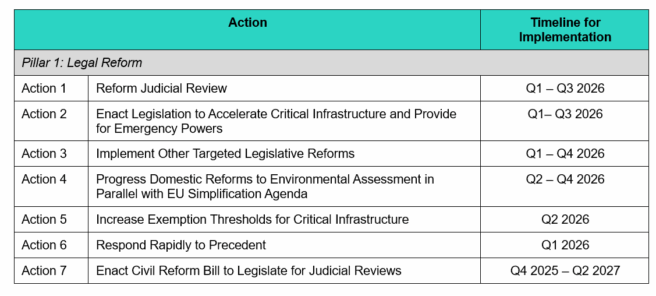
The Report proposes a programme of legislative reforms to speed up infrastructure delivery, with the stated aim of reducing litigation and challenges to the consenting process. The Report references bringing forward legislation to clarify rules on the entitlement to bring judicial review proceedings as well as on legal costs, remedies and fast-track pathways for nationally significant projects. It also includes new proposed legislation, which are intended to speed up the planning process:

  • Critical Infrastructure Bill: Which would impose a legal obligation for State bodies to fast-track critical infrastructure through the planning, licensing, and other consenting stages. It also aims to incorporate statutory timelines, positive presumptions, and other measures to reduce procedural delays.
  • Emergency Powers: Which would provide emergency powers that will allow the Government to speed up specific critical infrastructure in emergencies.

The Report also involves several proposed reforms to judicial review procedure and costs, including the costs recoverable in some judicial review applications. Public consultation on a proposal to introduce a scale of fees to be applied in certain environmental judicial reviews also opened on 3 December 2025 and closes at 5:30pm on 15 January 2026.  A link to the consultation is available here.

Pillar 2: Regulatory reform and simplification

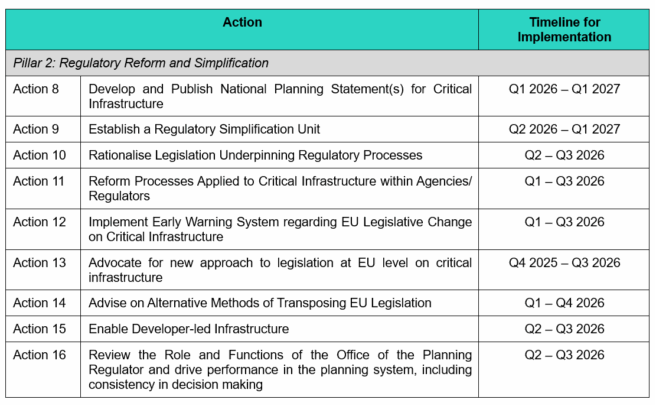
The Report notes that Ireland’s regulatory landscape has become overly complex. It aims to examine the practices applied by regulatory bodies and how they communicate with one another and applicants to simplify the process. This will involve applying parallel processes, mandating statutory timelines, and measuring the performance of regulatory bodies.

Key actions include:

  • establishment of a Regulatory Simplification Unit;
  • considering of General Binding Rules to reduce the need for regulation;
  • an explicit obligation on State agencies to engage with other State agencies and private developers;
  • implementation of an early warning system regarding EU legislative change on pressing infrastructure;
  • enabling developer-led utility infrastructure; and
  • establishment of an early warning system learning from precedent case law to improve regulatory processes.

Pillar 3: Coordination and delivery reform

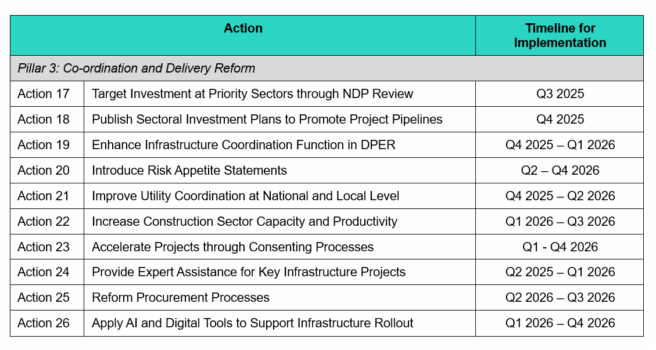
This pillar addresses several barriers frequently encountered by Irish infrastructure projects, such as risk aversion, procurement challenges, coordination of approvals and inconsistent planning decisions. To mitigate these issues, the Government intends to implement a number of reforms, including:

  • the introduction of risk appetite statements;
  • reforms to the procurement process; and
  • applying AI and digital tools to support infrastructure rollout.

The proposed actions are designed to increase construction sector capacity, drive greater competition, and strengthen value for money, thus creating greater efficiencies from the increased capital investment.

Pillar 4: Public acceptance

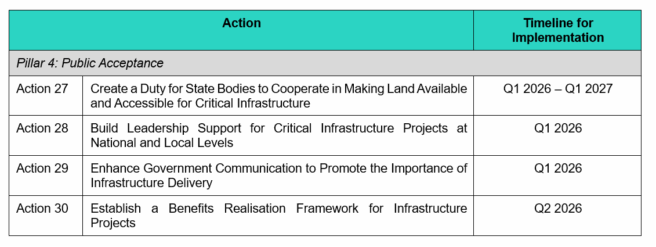
The final pillar of the Report is centred around public acceptance which the Report refers to as a ‘foundation of timely delivery’. The actions target public resistance and land access delays and aim to build trust, improve transparency and ultimately accelerate infrastructure delivery. This involves creating a duty for State bodies to cooperate in making land available and accessible for critical projects, enhancing Government communication to promote the importance of infrastructure delivery and establishing a Benefits Realisation Framework for infrastructure projects.

Timeline of proposed milestones

Most actions are targeted for completion in the first two quarters of 2026, which reflects the Government’s ambitious approach to acceleration. The timelines for the proposed milestones are set out below:

The Taskforce will remain in existence to oversee the implementation of the above actions.

For more information, please contact Ross MooreJohn DallasAlan RobertsAlison FanaganLachlan Muir, or a member of either the Energy, Infrastructure & Natural Resources or the Environmental & Planning teams.

The Planning and Development Act 2024 (the 2024 Act) was signed into law on 17 October 2024. At the time, the Minister for Housing, Local Government and Heritage commented that it could take up to two years to commence in full. Having reached the first anniversary of enactment, now is a good point in time to assess progress on commencement of its provisions.

On 4 March 2025, the Department of Housing, Local Government and Heritage (the Department) published an implementation plan setting out the phased commencement of the 2024 Act (the Implementation Plan). This plan was revised most recently in October 2025. In recognition of the imperative of ensuring a smooth transition to the new planning regime, the Department set up a dedicated website for the rollout of the 2024 Act, which includes commencement orders and circulars.

Phased commencement: what has already been introduced?

The 2024 Act is being commenced on a phased basis in line with the Implementation Plan. The following are some of the key provisions which have already been commenced.

Plans, policies and related matters

Part 3 of the 2024 Act was partially commenced on 2 October 2025. The commenced provisions provide the statutory basis for the National Planning Framework and Regional Spatial and Economic Strategies. The provisions relating to National Planning Statements, which replace section 28 Ministerial guidelines issued under the Planning and Development Act 2000 (the 2000 Act) were also commenced on this date. The provisions relating to development plans and other plans (including urban area plans and priority area plans) are due to be commenced in the next wave of commencements.

Judicial review

Chapter 1 of Part 9 of the 2024 Act came into operation on 1 August 2025. This provides for the reformed judicial review process and procedures under the 2024 Act. It is important to note that the new regime only applies to decisions or acts of a planning authority or An Coimisiún Pleanála made under the 2024 Act (of which, as yet, there are none). The old judicial review regime under the 2000 Act still applies to all decisions made under the 2000 Act.

A recent government press release confirms cabinet approval for a new bill to make amendments to the 2024 Act (the Bill). According to the press release, the Bill will extend the judicial review provisions of the 2024 Act to decisions made, or acts done, under the 2000 Act. The General Scheme of the Bill has not yet been published.

Section 180 of the 2024 Act was also commenced on 1 August 2025 and provides for the suspension of the running of the duration of planning permissions which are the subject of a judicial review challenge.

An Coimisiún Pleanála

The provisions relating to the restructuring and renaming of An Bord Pleanála came into operation on 18 June 2025. 

Urban development zones (UDZs)

A number of provisions relating to the identification of suitable sites for potential UDZs commenced on 9 June 2025. The remaining provisions in Part 22 are due to be commenced in the next wave of commencements.

Phased commencement: what is yet to come?

Judicial review costs regime

The provisions relating to the new environmental costs regime in Part 9, Chapter 2 have not yet been commenced. Under the Implementation Plan, Chapter 2 is to be part of the final block of commencements.

Development consents

Part 4 of the 2024 Act is still awaiting commencement. In line with the Implementation Plan, it is expected to commence in the penultimate block of commencements. Part 4 consolidates the various processes for obtaining planning permission and the previous definitions of “development” into a single, unified definition for both maritime and non-maritime contexts.

Environmental assessments – partial implementation

2 October 2025 saw the partial commencement of Part 6 of the 2024 Act. Chapters 1 and 2 of Part 6 of the 2024 Act are now in force and relate to preliminary matters and also to the appropriate assessment of plans. The remainder of Part 6, relating to the appropriate assessment and environmental assessment of development and proposed development, is expected to be commenced as part of the penultimate block of commencements.

Compulsory acquisition of land and maritime sites

None of the provisions of Part 14 of the Act have been commenced to date. According to the Implementation Plan, these provisions are due to be commenced in the final block of commencements.

Financial and miscellaneous provisions

Section 587 of the 2024 Act provides for a new criminal offence of requesting payments or benefits in exchange for not opposing a development or for withdrawing opposition to a development.

Section 588 introduces a new requirement for submissions, observations, appeals and judicial review proceedings to be accompanied by a statutory declaration that they are not being made, or taken, to delay the development or secure any benefits.

Neither provision has as yet been commenced and, according to the Implementation Plan, both are due to be commenced in the penultimate block of commencements.

Strategic development zones (SDZs)

None of the provisions relating to SDZs (Part 21) have yet been commenced. Part 21 is expected to commence in the final block of commencements.

Next steps

The remainder of the 2024 Act is expected to be commenced over the next year or so, with a further commencement order expected before the end of this year. Given the complexity and scale of the 2024 Act, the dedicated government website will continue to be a useful resource to keep track of progress. New regulations under the 2024 Act will require scrutiny once published and the detail of the new environmental legal aid costs regime is awaited with interest.

We will provide further updates in due course but should you have any queries in the meantime please contact your usual ALG Environmental and Planning contact or Rachel Kemp, Senior Practice Development Lawyer.

The Irish Government has today published “Delivering Homes, Building Communities 2025–2030” (the Plan), its much-anticipated housing strategy that introduces reforms aimed at boosting supply, improving viability and creating a more stable investment environment. While the Plan includes several material changes for PRS investors and developers – particularly those focused on multi-unit apartment schemes – many of these changes have already been announced over the course of the year and will not therefore be unexpected.

Overall aims

The Plan aims to activate large-scale supply across all tenures, drive down the cost of building new homes (particularly apartments), strengthen protections and supports for renters and provide a more predictable regulatory and investment environment. The overall stated target is to support the delivery of 300,000 homes over the five-year lifetime of the Plan, although it is worth noting that annual targets have been done away with.

The Government recognises that an estimated €20 billion in development finance will be required to support the delivery of these homes and that the significant majority of the required funding will need to come from investment by the private sector, to support both home ownership but also a well-functioining private rental market.

Key features

A more predictable rent framework

One of the key interventions from the Government’s perspective is the introduction of a new national system of rent controls. As previously reported, for most properties annual rent increases will be capped at 2% or inflation (CPI), whichever is lower. Crucially, however, new-build apartments will operate under CPI-linked increases only, recognising the need to attract and retain investment in new rental stock. The ability to reset rents to market levels between tenancies is also intended to help stimulate investment.

Stronger tenant protections

The plan also references the intention to introduce minimum six-year tenancies, with rent reviews allowed at the end of each term. While termination grounds will tighten, institutional landlords – already aligned with long-term occupancy models – are unlikely to be adversely impacted. These reforms aim to provide tenants with security while supporting investor confidence through regulatory clarity.

Reductions in apartment delivery costs

The Government’s main boost for viability comes through a package of cost-reduction measures which we have already flagged during the year, including:

  • VAT on apartment construction cut to 9%;
  • Enhanced corporation tax deduction for qualifying construction and conversion costs;
  • Revised apartment design standards offering greater flexibility and lowering build costs; and
  • Standardised design approaches and increased support for modern methods of construction.

According to Government, the combination of these measures has the potential to reduce delivery costs by €88,000 to €160,000 per apartment, substantially improving the economics of large-scale schemes.

Planning reform and supply activation

The ongoing implementation of the Planning and Development Act 2024 will introduce statutory decision timelines, increased resourcing for planning bodies and greater certainty for developers. The creation of Urban Development Zones is also intended to unlock sites capable of supporting high-density apartment delivery.

Unlocking infrastructure

The Plan places a strong emphasis on unlocking infrastructure constraints that have slowed housing delivery, to include the introduction of a new €1 billion Infrastructure Investment Fund and dedicated national structures to accelerate enabling works. This is in addition to the formation of the Housing Activation Office, which is specifically tasked with removing infrastructure delays. The overall aim is to ensure that infrastructure keeps pace with high-density development.

Cost rental expansion

The Government will significantly scale up cost rental delivery through enhanced funding streams, a new corporation tax exemption for cost rental income and changes to the STAR equity model.

Student accommodation

The Plan also places renewed focus on student accommodation, with a Student Accommodation Strategy 2025–2035 to be published shortly. This is to be aimed at significantly expanding purpose-built supply and reducing the number of students competing in the private rental market.

Land Development Agency

The Plan also significantly scales up the role of the Land Development Agency (LDA), with an additional €2.5 billion in equity funding bringing its total capital allocation to €8.75 billion . The LDA’s remit is expanded to cover a wider geographic area, acquire more public and private land and invest directly in enabling infrastructure.

What this means for PRS stakeholders

Overall, the plan signals a clear policy shift toward:

  • Greater certainty for purpose-built rental schemes;
  • Improved viability through substantial cost reductions and tax measures;
  • A more transparent and regulated rental environment;
  • A stronger pipeline for both private and mixed-tenure apartment delivery.

For investors, developers and operators in the multi-unit rental sector, the reforms represent one of the most supportive policy landscapes in recent years. There is, however, still much work to be done in operationalising these new policies and further analysis will be required as each strand progresses.

If you have any queries, please contact Aoife Smyth, Practice Development Consultant, or your usual ALG Real Estate contact.

The Department of Housing, Local Government and Heritage yesterday published further clarifying information regarding the residential tenancy reforms which it announced in June. This is in anticipation of publication of the legislation needed to give effect to these changes, which the Government says is to be published “later this year”.  This is a relatively unusual step and reflects both the significance of these reforms from a policy perspective and market demand for further information on how the reforms are to operate.

Setting of rent on review

The new materials confirm the previously announced reforms to rent controls for new tenancies entered into from 1 March 2026 (New Tenancies). This will be a nationwide cap of 2% or the rate of inflation, whichever is the lower. It is also confirmed that the reference index for the purposes of calculating the rate of inflation will be CPI and not HICP. Both indexes sit at 2.7% as at end October 2025.  This will also be the mechanism for reviewing rent for existing tenancies (i.e. those in place on 28 February 2026).

These restrictions will not apply to newly built apartments and student-specific accommodation (SSA). In each case “newly built” means units which are the subject of a commencement notice dated on or after 10 June 2025. Rent increases for these newly built properties will be in line with CPI and not subject to the 2% cap.

Resetting of rent to market

The ability to reset the rent to market in certain circumstances is also confirmed, when:

  • A tenant leaves voluntarily;
  • The tenancy is terminated for tenant breach;
  • The property no longer meets the tenant’s needs (e.g. size, accessibility); or
  • At the end of each 6-year TMD (see below for further information).

Student accommodation

The documentation published yesterday indicates that, as student arrangements generally change every year, the new rent controls will be tailored specifically for SSA. The proposal is that SSA owners will not be permitted to reset rents / licence fee to market on the commencement of each student licence, but rather that readjustment to market value will be permitted every 3 years during which the property remains in operation as SSA.

The guidance does not clarify the specific rent increase restrictions which will apply to SSA during the 3 year periods, nor the rhythm of the 3 year periods, and we await the draft Bill to provide further clarity on this.

Tenancies of Minimum Duration

The Government has confirmed its intention to introduce tenancies of minimum duration (TMD) for New Tenancies. The new rules will apply to PRS units, as well as HAP (Housing Assistance Payment), RAS (Rental Accommodation Scheme) and cost rental units. It seems that TMDs will replace the existing Part 4 regime for these New Tenancies.

TMDs will be rolling 6-year tenancies, arising once a tenancy has been in place for 6 months, during which landlords will not be able to serve a notice of termination other than in very limited circumstances. For larger landlords (4 or more tenancies), the sole grounds for termination will be (i) breach of tenant obligations and (ii) if the property is no long suitable for the tenant’s needs. The documentation confirms that larger landlords of New Tenancies will not be permitted to terminate on the other existing Part 4 grounds, to include the substantial renovation of the property.

Note that the materials make it clear that the 6-year duration of TMDs binds the landlord only – a tenant is free to terminate at any stage, subject to providing the requisite notice. It seems that the notice periods for tenants will be broadly similar to what they are under the existing Part 4 regime, although this is to be further clarified on publication of the legislation.

Rent register

Rental amounts for each tenancy will be included on the RTB’s publicly available rent register, without disclosure of the address or the identity of the landlord or tenant. It is at this point unclear, in the absence of an address, how much detail will be provided regarding the location of the tenancy in order for the register to be of use for the purpose of establishing market rent by way of comparables.

In summary

The publication of this information is a helpful interim step whilst we await the amending legislation which will give effect to these policy changes. However, we would caution against reliance on its content – only the legislation will provide the necessary certainty on how these various changes are to operate in practice.

As ever, we will continue to monitor these and related developments.  In the meantime, should you have any queries please contact Aoife Smyth, Practice Development Consultant, or your usual ALG Real Estate contact.
The Irish Government today published its Budget 2026, which includes a number of taxation measures designed to stimulate housing supply.

Change in VAT rate applicable to the sale of new residential apartments

There is a positive change in relation to the VAT costs arising on the sale of new residential apartments. It has been announced that from 8 October 2025, VAT is chargeable at 9% in substitute for 13.5% in relation to the sale of certain immovable goods as residential apartments. The reduction is to remain in place up to 31 December 2030.

The financial resolution introducing this change specifies that the rate will apply to the supply of a new apartment used or to be used for residential purposes. The reduction should apply to the VAT chargeable on sale of a new apartment in a multi-storey residential property that comprises, or will comprise, not less than 3 apartments with grouped or common access.

New corporation tax exemption for Cost Rental income

Another positive change is the introduction of an exemption from Irish corporation tax for rental profits from Cost Rental homes.

The exemption will apply in respect of properties designated as Cost Rental by the Minister for Housing, Local Government and Heritage from 8 October 2025.

The exemption is intended to accelerate the delivery of affordable homes to the market and to incentivise investment in this space.   

Enhanced corporation tax deduction for apartment construction costs

An enhanced corporation tax deduction was announced for costs incurred on the construction of apartment developments and the conversion of non-residential properties into apartments.

The Budget materials note that the measure will allow an enhanced corporation tax deduction of 125% of the qualifying costs, up to a maximum additional deduction of €50,000 per apartment unit. The proposed deduction is to be subject to a number of conditions and will be available in respect of projects for which a commencement notice is submitted between 8 October 2025 and 31 December 2030.

Renewal of and updates to the Residential Development Stamp Duty Refund Scheme

The Residential Development Stamp Duty Refund Scheme provides for a partial repayment of the stamp duty paid on the acquisition of land, where the land is subsequently developed for residential purposes. This is subject to a number of conditions, including time limits relating to commencing work and completing development.  

Budget 2026 extends the refund scheme, which was due to expire at the end of this year, until 31 December 2030.

Certain positive changes were also announced to the time limits relating to commencing work and completing development. These have both been extended to 36 months, from 30 months. This should enable more tax-payers to avail of the refund scheme.

The Minister for Finance also announced that he would be providing for a full stamp duty refund to be claimed in respect of a multi-phase development at the commencement of the first phase of that development.

Residential Zoned Land Tax

The Minister for Finance announced the provision of a further opportunity for landowners to make a submission requesting a change in the zoning of their land (which currently appears on a local authority’s revised RZLT map for 2026). Subject to making this submission, this could potentially result in the relevant site being exempted from RZLT for 2026.

The Minister flagged that further changes to ensure that the RZLT legislation operates as intended are also being included in Finance Bill 2025. It is hoped that these changes will address certain technical issues with the RZLT legislation, which have impacted genuine development structures with unforeseen RZLT costs.

New Derelict Property Tax

A new Derelict Property Tax was announced. This new tax will be collected by the Revenue Commissioners and will replace the existing Derelict Sites Levy.

The Minister for Finance noted that the earliest that the tax would be in operation is 2027 and that it is envisioned that the rate would be no lower than the current 7% charge under the Derelict Sites Levy. It was announced that the new tax would be legislated for in next year’s Finance Bill.

In summary

Oveall, Budget 2026’s tax measures relating to housing should reduce costs and enhance the viability of new housing schemes, and apartments in particular. Further detail in respect of certain of the measures, particularly around RZLT and the new Derelict Property Tax, are needed and we will provide updates on these elements as they progress.

For further information in relation to this topic or any related matter, please contact your usual ALG Real Estate or Tax contact.

Photo of Paul McNamee

The Construction Contracts Act 2013 (the CCA 2013) gives parties to a construction contract a statutory right to refer a dispute relating to payment to adjudication. However, since the commencement of the CCA 2013 in July 2016, a lack of clarity has existed as to what constitutes a dispute relating to payment.  

This lack of clarity has been addressed by the decision of Simons J of the High Court in Albert Connaughton v Timber Frame Projects Ltd t/a Timber Frame Ireland [2025] IEHC 469.  The judgment will have consequences for employers, main contractors and subcontractors both in respect of:

  • the disputes that they may considering referring to adjudication, and
  • the negotiation of certain contractual terms

The Background

The parties had entered into a bespoke construction contract for the design, supply and erection of a timber frame structure. The contract was described as “sparse” compared to the detailed terms found in standard form contracts (such as the RIAI, NEC or JCT forms). Notably, it made no provision for termination payments.

The Employer purported to terminate the contract, alleging repudiatory breach and seeking common law damages after the Contractor allegedly failed to erect a timber frame house by the completion deadline. The Employer was successful at adjudication and obtained a monetary award in its favour for recovery of the purchase price paid as well as for its consequential losses. It then sought to enforce this award in the High Court.  

The Contractor sought to resist the enforcement application on three grounds:

  1. the adjudicator lacked jurisdiction as this was a dispute relating to payment that did not have its basis in a particular term under the contract;
  2. the adjudication process did not comply with fair procedures; and/or
  3. the underlying contract was tainted by illegality because the proposed erection of the timber structure would have involved a breach of planning permissions.

The Contractor was successful on the first of these three grounds. While this judgment covers a variety of different issues, it is the issue of what constitutes a dispute relating to payment that is the focus of this article.  

The Decision

In determining the core question as to what is a “dispute relating to payment” that can be referred to adjudication, the Court held:

“the right to refer a dispute to statutory adjudication is confined to circumstances where the dispute relates to a payment which is provided for under contract. The referring party must either be asserting or resisting a claim to be paid an amount which is provided for under the construction contract, i.e. a payment which is expressed or stipulated in the terms of the contract.”

In short: a dispute can only be referred to statutory adjudication if that dispute relates to a payment that is expressly provided for under the contract. A dispute relating to the payment of amounts that may be owed in relation to the contract, but which are not expressly provided for in the contract (for example, a common law claim for damages for a repudiatory breach of the contract) cannot be referred to adjudication.

The Impact

While there was judicial commentary regarding the practical application of the CCA 2013 in other respects (namely, whether the service of a payment claim notice is a prerequisite to a subsequent referral to adjudication and the extent of any monetary claim that a paying party (i.e. an Employer or Contractor) under a construction contract may be able to pursue in adjudication against its counterparty) the real impact of this judgment is around its pronouncements on payment disputes.

This judgment will have both immediate and long-term consequences for parties to construction contracts. In the immediate term, the judgment brings welcome clarity as to the question of what constitutes a payment related claim that can be referred to statutory adjudication. This is likely to inform and affect the dispute resolution strategies that parties adopt going forward.

In the medium to longer term, the decision is likely to impact upon parties’ negotiation of their construction contracts with an increased focus on terms related to contractual damages (such as in the context of termination) and the right of a paying party to set-off certain costs against amounts that it owes to its counterparty.

For further information in relation to this topic or any related matter, please contact Clare Cashin, Partner, Paul McNamee, Associate, Eibhlín Clinton, Solicitor or your usual contact on the Construction & Engineering team.

The Irish Government yesterday published its Review of the National Development Plan (NDP), which outlines a record €275.4 billion infrastructure investment programme through to 2035. Central to this is the delivery of 300,000 new homes by 2030, underpinned by significant investment in enabling infrastructure, particularly water, energy and transport.

This note highlights the key housing-related measures contained in the revised NDP.

Direct housing investment and delivery targets

The revised NDP allocates €35.955 billion to the Department of Housing, Local Government and Heritage, the largest sectoral allocation under the plan. Of this, €28.275 billion is allocated to housing and €7.68 billion to water.

The plan states that the largest component of the capital allocation for housing will provide for:

  • the Programme for Government commitment to deliver 12,000 new-build social homes annually (2026–2030); and
  • a new Starter Homes Programme aiming for 15,000 units per year, supporting home ownership.

Infrastructure to unlock housing supply

Housing delivery is expressly linked in the plan to large-scale investment in supporting infrastructure, as follows:

  • Water: €7.68 billion via the NDP and a further €4.5 billion in Government equity funding for Uisce Éireann, broken down between:
    • €2 billion in 2025 to facilitate additional capacity for housing development and compliance with EU water standards; and
    • €2.5 billion earmarked for 2026 to 2030, specifically to support large-scale water infrastructure projects.
  • Energy: €3.5 billion in equity funding to ESB and EirGrid to expand electricity transmission and distribution network infrastructure.
  • Transport: €22.33 billion, including provision for Metrolink and active travel.

Each of these investments are intended to deal with infrastructure deficits which are currently perceived to be causing bottlenecks to residential delivery. These allocations will enable forward planning, zoning, and investment decision-making for development land.

Key Legal and Regulatory Developments

Planning reform: Planning and Development Act 2024

The revised NDP calls out the importance of the broader reforms to the planning system which are underway, and in particular the Planning and Development Act 2024, referencing key reforms such as:

  • Clearer pathways and timeframes for planning consents;
  • Reform of judicial review processes;
  • Extended ten-year development plan cycles with mid-term reviews; and
  • Mandatory alignment with National Planning Statements, replacing ministerial guidelines and aimed at ensuring consistency across planning decisions.

The stated intention of these reforms is to “enhance to enhance delivery certainty, reduce legal and procedural delays, and ensure that infrastructure projects can proceed in a timely and coordinated manner”.

Design standardisation and Modern Methods of Construction

In July, the Department of Housing, Local Government and Heritage published new guidelines mandating the use of standardised design layouts and specifications for all new-build social housing projects development by local authorities and approved housing bodies. These guidelines are expected to become operational in Q3 of 2025.

These guidelines are intended to support the simultaneous drive toward the adoption of Modern Methods of Construction, which the Government believes to be needed in order to mitigate the labour supply pressures experienced in the provision of housing.

The guidelines referenced above are separate and in addition to the Design Standards for New Apartments, also published this month, which have a broader application and also demonstrate the overall aim of aim balancing regulatory standards with increased housing output.

In conclusion

The 2025 NDP Review confirms the centrality of housing in national infrastructure planning and funding. However, it contains little detail on specific measures to be taken by the State in spending the various sums allocated. The Minister for Public Expenditure and Reform yesterday indicated that Minsters would “work on the specific sectoral plans and investment plans over the next five years”, and we will therefore have to wait for further meaningful detail on the potential opportunities presented for those operating within the housing market.

For further information, please contact Aoife Smyth, Knowledge Consultant, or your usual ALG Real Estate contact.
On 8 July 2025, the Minister for Housing, Local Government and Heritage and the Minister of State for Local Government and Planning jointly issued the Design Standards for Apartments, Guidelines for Planning Authorities (the Guidelines), pursuant to Section 28 of the Planning and Development Act 2000 (as amended) (Section 28). The Guidelines set out national planning policy for apartment development, reflecting current Government priorities and the revised legislative framework introduced by the Planning and Development Act 2024. They reaffirm the importance of a plan-led system informed by national policy.

Key provisions address apartment mix, internal space standards, dual aspect ratios, floor to ceiling heights, stair/lift core ratios, storage, and amenity spaces such as balconies and patios. The overall aim is to balance regulatory standards with increased housing output, ensuring quality while supporting viability.

The Guidelines apply to all planning applications submitted on or after 8 July 2025.

The legal status of Specific Planning Policy Requirements in the Guidelines

Section 28 requires planning authorities and An Coimisiún Pleanála to have regard to Ministerial Guidelines and to apply any Specific Planning Policy Requirements (SPPRs) set out therein.

“Have regard to” means that the planning authorities can depart from the Guidelines, provided they have taken them into account. However, where SPPRs are included in the Guidelines, they take precedence over any conflicting provisions in statutory development plans. In such cases, planning authorities are expected to amend their plans to ensure consistency with the Guidelines and decide planning applications in accordance with the SPPRs, pending any such amendments.

There are a number of SPPRs included in the Guidelines, relating to areas such as housing mix, apartment design standards and shared accommodation / co-living sectors.

Amending existing permissions: Government to enable retrospective adoption of new standards

The Government intends to allow developers to amend existing planning permissions to incorporate the updated 2025 Guidelines, without needing to submit entirely new applications. The Planning and Development (Amendment) Bill 2025, which was passed last week, introduces (at section 29) provisions that allow developers who have already secured planning permission to build smaller and more apartments in the same scheme, without submitting a fresh planning application, but rather by applying for a “permitted modification”, which the relevant planning authority must determine within eight weeks. These changes can be considered the first formal step toward streamlining the planning process for housing delivery and reducing regulatory friction for projects already in the pipeline.

For further information, please contact Alison Fanagan, Consultant, Alan Roberts, Partner, or Brendan Curran, Senior Associate, of our Environmental & Planning team.

Irish local authorities are due to have made all of their decisions on this year’s Residential Zoned Land Tax (RZLT) maps by 1 July. What steps can landowners take now to deal with an unfavourable decision?

RZLT is the tax introduced as part of the Government’s “Housing for All” plan, affecting residential and mixed-use land identified on an annually updated map, prepared by the local authority. Owners of land zoned for residential had the opportunity to make submissions setting out their reasons against inclusion of lands on the local authority RZLT maps. The deadline for these submissions was 1 April 2025. The relevant local authority must make its determination by 1 July 2025. The land owner has until 1 August 2025 to appeal the local authority decision regarding submissions. These appeals must be made to An Coimisiún Pleanála (formerly An Bord Pleanála).

It is important to understand the reasoning for the local authority determination. Often a local authority will issue a decision letter and there may be an underlying planner’s report but that may not be included with the letter. Requesting this planner’s report in the first instance is important.

The deadline for appeal is only one month and runs out over the summer months, when key personnel may be on leave. Early engagement with your development team and external planners and solicitors is key to making a strong appeal.

Once the appeal is lodged there is a notional decision date of 31 October for the appeal decision. Some local authorities issue earlier so keep an eye out for the decision. The only avenue for challenging an appeal decision is by way of judicial review. There is a 3 month deadline for judicial review of this decision.

Please see our webinar linked here for KnowledgePlus subscribers which provides an insight into the lessons learned by ALG’s taxreal estate and environmental & planning lawyers on RZLT. KnowledgePlus is available exclusively to A&L Goodbody LLP clients.

For more information, or to request access for you or your team, please contact Alison Fanagan, Consultant, Paul Fahy, Partner, James Somerville, Partner.or your usual ALG contact.

The Minister for Housing, Local Government and Heritage has announced a significant expansion of the Land Development Agency’s (LDA) mandate, aimed at enhancing the delivery of affordable and social housing across Ireland. This development follows a review by the Cabinet Committee on Housing and is intended to align with national planning priorities for sustainable urban and regional development.

Key Measures

The expansion of the LDA’s role will be advanced through six principal measures:

Active land management and private housing delivery

The LDA will further develop its land bank, adopting active land management policies and delivering private housing in suitable locations, in addition to its existing focus on social and affordable housing.

Geographical expansion

The LDA’s operational remit will be broadened to cover a wider geographical area, enabling the Agency to support housing delivery in more communities nationwide.

Unlocking strategic public lands

A focus will be placed on unlocking key strategic public lands, particularly urban brownfield sites, through targeted infrastructure investment to facilitate housing development.

Amendments to land transfer provisions

Provisions of the LDA Act relating to the transfer of lands from commercial state bodies will be amended to expedite the development of suitable sites for housing.

    Tax treatment of cost rental activity

    The LDA will collaborate with the Department of Finance to address the tax treatment of its cost rental activities, with a view to supporting the viability and expansion of affordable rental housing.

    Support for local authorities and master planning

    The LDA will provide enhanced support to local authorities, the newly established Housing Activation Office, and relevant government departments in master planning and infrastructure provision for new towns and districts.

    Implementation and Next Steps

    The Cabinet Committee on Housing has agreed in principle to these recommendations. Relevant Government departments, the LDA, and the Housing Activation Office will now work together to advance the necessary actions and develop detailed proposals for Cabinet approval and implementation.

    We will provide further information in due course but please feel free to direct any queries in the meantime to Aoife Smyth, Knowledge Consultant, or your usual ALG Real Estate contact.